

BART successfully completed the installation of 715 new fare gates systemwide in August 2025, replacing 20-year-old legacy gates and beating its deadline to have new gates in all 50 stations by the end of 2025. The new gates have changed the feel and appearance of stations and are already serving as a strong deterrent against fare evasion. The gates bring a new look and improved experience, offering state-of-the-art technology that is boosting safety by deterring fare evasion.
Riders can provide feedback about the fare gates by using our comment form.
Project Benefits
• Improves safety and boosts ridership: tall swing barriers and mechanical locking mechanisms on each gate make it difficult for fare evaders to push through, hurdle over, and maneuver under.
• Improves customer experience: advanced sensors on each gate detect wheelchair users and those with luggage, strollers, or bikes to ensure they get through with ease, while LED lighting assists visually impaired riders, and a bell “chime” tone helps visually impaired riders know when a gate is open.
• Enhances monitoring: sensors on each gate help identify fare evasion events for future improvements and provide real-time monitoring capabilities.
• New payment options: every gate is compatible with the next generation of Clipper, which accepts open payment with the ability to pay by tapping a credit or debit card or a phone/watch with Apple Pay or Google Pay.
Demonstrated successes
• Crime dropped 41% in 2025, with crimes against persons down 67% (per million riders)
• Fare revenue is up by ~$10M with reduced fare evasion
• Customer Satisfaction was up to 91.4% in FY26 Q4 from 83% in FY25 Q1
• Riders who say they witnessed someone not paying has dropped 59% in the last year
• Approximately 30% reduction in time spent fixing and cleaning vandalism, graffiti, and large messes


Funding
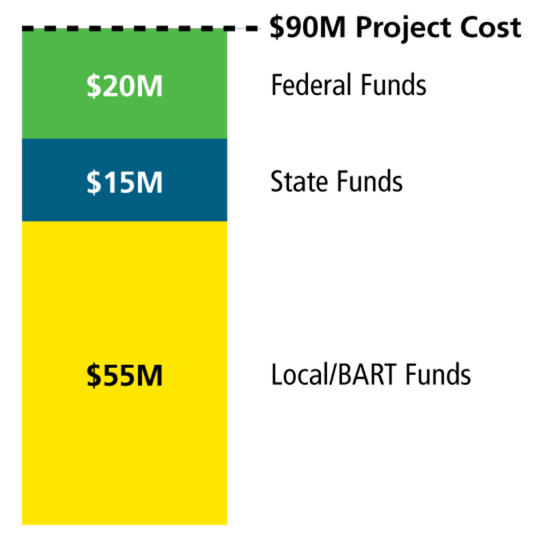
BART secured $90 million for the NGFG project including:
- $20 million in federal funds
- $15 million in state funds
- $55 million in local/BART funds
Thank you to our funding partners:
- United States Department of Transportation (USDOT)
- Federal Transit Administration (FTA)
- State of California
- California Transportation Commission (CTC)
- California Department of Housing & Community Development (HCD)
- Metropolitan Transportation Commission (MTC)
- Alameda County Transportation Commission (ACTC)
- Contra Costa Transportation Authority (CCTA)
- San Francisco County Transportation Authority (SFCTA) Prop L Transportation Sales Tax
- San Francisco International Airport (SFO)
- San Mateo County Transportation Authority (SMCTA)
- Santa Clara Valley Transportation Authority (VTA)
- South Hayward Joint Powers Authority (JPA)
Installing new fare gates to prevent fare evasion was an accountability requirement for BART to receive SB 125 emergency state funding in response to the COVID-19 pandemic.


Project background
Timeline of procurement
- BART posted a Competitive Negotiation (Best Value) Request for Proposal for our Next Generation Fare Gates on May 31, 2022, and then again on December 2, 2022.
- Proposals were reviewed beginning in January of 2023, and responsive vendors were interviewed by a BART panel.
- On March 23, 2023, staff recommended STraffic America to implement the project.
- On April 13, 2023, the BART Board awarded the contract to STraffic America.
On December 28, 2023, BART opened new prototype fare gates at West Oakland Station.
At the pilot in West Oakland Station, BART tested three different door materials (polycarbonate only, polycarbonate framed with metal, and polycarbonate with a perforated metal insert) and selected to advance the polycarbonate framed with metal gates.
At the April 13, 2023, BART Board of Directors meeting, the Board moved forward with the first purchase of the $90 million Next Generation Fare Gate project. The board awarded up to $47 million to STraffic America to implement the project. The project called for all stations to have new fare gates by the end of 2025.
The new fare gates look unlike any other of the old gates in the BART system. The gates have clear swing barriers that are very difficult to be pushed through, jumped over, or maneuvered under. The overall fare gate array height (gate, console, integrated barrier) forms a tall barrier of 72” minimum to prevent fare evasion.
The new gates don't have the orange fins riders were accustomed to with BART’s former legacy gates.
The new gates are able to handle large crowds without slowing people down as they move in and out of stations while processing their Clipper cards.
Board presentations outlining the Next Generation Fare Gates project:
July 9, 2026 – Fare Gate Enhancements & Station Hardening Update
December 5, 2024 – Project update
August 15, 2024 – Next Generation Fare Gates Deployment Schedule
July 11, 2024 – Project Update
January 11, 2024 –Project Update
September 14, 2023 – Project Update
July 19, 2023 – Letter to Bay Area Council with Initial Fare Gate Deployment Schedule
April 13, 2023 –Vendor Selection & Early Concept Renderings
March 23, 2023 – Project Update & Vendor Recommendation
March 24, 2022 – Project Update
June 10, 2021 – Project Update
December 3, 2020 – Project Update
June 11, 2020 – Project Update
September 26, 2019 – Fare Gates & Fare Evasion
May 23, 2019 – Project Update & Conceptual Design
Station Hardening
Station hardening includes changes to BART infrastructure that go beyond installing new fare gates. Changes include heightened barriers around paid areas, alarmed swing gates and exit doors, and elevators moved into paid areas. All these elements make it more difficult for fare evaders to bypass paid areas.
Station hardening is a substantial systemwide effort, leveraging new and existing operating and capital funds from a variety of sources into a wide range of projects.
Proof of payment
Proof of payment began on January 1, 2018, with a two-month warning period for first time violators. Fare inspectors increase police presence on trains and in stations. They deter fare evasion, encourage compliance over time, and promote customer equity sending the message that everyone must pay their fair share.